The Far East & Pacific
- Golpak – “Number One Friend Belong Australia True” & ‘The School that fell from the sky’.
- The Naga Queen – Ursula Graham Bower.
GOLPAK “Number One Friend Belong Australia True” & ‘The School that fell from the sky’
By Roger Stanton
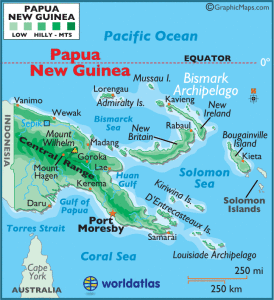
It all began on the 3rd Nov 1943. Bill led his Squadron (22 Squadron) on a sortie from Goodenough Island, just north of Milne Bay, to attack the Japanese invasion barges that had been gathered in New Britain. Flying a Boston armed with bombs, and flying at low level, David successfully bombed the targets. The AA fire from the ground was very heavy, and just when he was about to target a bridge with his front guns his port engine packed in. After congratulating himself on having a second engine, a quick glance at his starboard engine soon shattered his illusions; he saw a shell exiting the top. With both engines out of action he had no option but to ditch. He landed like a flying boat, the dinghy popped out, and they paddled the 400m towards the shore. Fortunately, the jungle ran straight down to the shore-line and they were able to get into cover before the Japanese search teams could locate them.
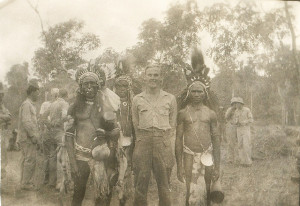
After eleven days on the run, and surviving on the jungle and their survival rations, the men found a track that led to a native village. Friendly natives took them in, gave them food and water, and the men slept happily in smoke filled huts. This was paradise compared to sleeping on the jungle floor with the monsoon rains, mosquitoes and leeches for companions. After a short while the natives took their evaders to another village where they were introduced to a man called Golpak. Golpak was the man in charge of the area. He wore an old Aussie hat, carried an old Winchester rifle, and greeted the men with a smile saying “I am number one friend belong Australia true”. He said he would look after them, hide them from the Japs, and return them to their own forces over 200 miles away across the Coral Sea!!!
Golpak kept his word. He had done it for others. The Japs were however quite near to the village and the two airmen were moved very quickly on a number of occasions. On one occasion they hid in deep water while the Japs searched the village, only to be told by Golpak when they got out, that the water was full of crocodiles. After two months being cared for by the villagers, and Jap patrols passing nearby and through the village of Sali, the two men were awoken one morning to the cries of “Japan ee cum”. A Jap patrol had raided the village early that morning and was arresting many villagers. Bill and Dave decided that they would leave the village for good rather than risk the lives of the villagers.
On advice from Golpak, the two men decided that they should head north across the mountain ranges to try to reach a group of Aussie Coast Watchers (SAS role), who had been inserted into enemy territory to report on enemy shipping, aircraft, and troop movements. They worked as very small teams carrying out sea and road watches, and tried not to make contact with the Japanese. They were supported by local people.
After very arduous trekking with a guide, much of the walking done in pitch darkness, David and Bill reached the area but were unable to find the Coast Watchers, - who instead, eventually found them instead!
Once contact was established, the pair then met up with Fred Hargesheimer, an American pilot evader who had also been hidden by Golpak’s group in another village. David and Bill had been looked-after by natives for nearly three months, but Fred had been hidden for nine months, and had spent weeks before that living in the jungle where he had developed fever and dysentery.
On Saturday 05 June 1943, Fred Hargesheimer was on a photo reconnaissance patrol in a P-38, over the north coast of New Britain. The Japanese were building up their forces around the Island of Lolobau, and photo intelligence was an urgent requirement to allow the B-25’s to do their job. While photographing what appeared to be a Japanese airfield his P-38, known as ‘Eager Beaver’, was attacked by a Japanese fighter. A parachute descent was the only option and, after crashing through eucalyptus trees, he landed in mud. Found to have a nasty head wound, he crushed sulphanilamide tablets, sprinkled them on to the wound, used pieces of parachute silk as a pad, and used a bandage to hold the lot in place. Armed with the issued survival kit, a booklet called ‘Friendly Fruits and Vegetables’, and wishing he had read the literature and listened to the survival briefings, Fred took stock of his situation. Seventy five miles of thick jungle, and two hundred miles of open sea needed to be covered to get back to his base. There were no paths to follow, a wall of foliage to get through, so with a compass in his hand, he set a course to reach the mainland.
By July 06, after a month in the jungle, having lost a lot of weight living on leaves, roots, snails and fish, and looking like a scarecrow with a beard, Fred felt tired, hungry, and very much alone when he heard voices. He froze; he had been spotted by locals in a canoe. Moving cautiously, he walked toward the canoe. The leader caught Fred’s arm, and a warm sympathetic smile came to his face. Fred was given food and shelter for the night, and next morning he was taken by canoe to a village.
On arrival at the village of Ae Ae (later Nantabu) a bed was made for him in a hut which he shared with the family of Luluai Lauo. Luluai was taken off for questioning on a regular basis by the Japanese so, during those times, Fred was often hidden in a mangrove swamp. When walking around the village Fred was always followed by small children whose job it was to erase his footprints.
For ten days Fred suffered badly from malaria, fever, and profuse sweating, during that time the villagers watched over him and nursed him. Later, hostile natives led a Japanese patrol to the village to search for the airman. Despite the threats of execution and beatings, no member of the village, including the children, ‘knew anything about any airman’! To be caught in a village by the Japanese would have meant beheading for Fred, and an equally barbaric death for the local population.
The village was later visited by a member of another tribe who wanted to pass a message on to the airman. Very suspiciously, Fred took the piece of paper and saw the name of a Capt Skinner, Coast Watchers. Fred was taken by canoe and introduced to Capt Skinner, the first white man he had seen in over five months.
The Coast Watchers were in radio contact with friendly forces, and reported on the three evaders to their base location. While waiting for instructions the three fugitives worked alongside the Coast Watchers, carrying out intelligence gathering. Finally a message came through instructing the men to go to a pre-arranged RV point to meet up with, what they thought would be, a sea plane that had been arranged to collect them. After a long trek through hostile terrain, the men arrived late at the RV, expecting their pick-up to be blown. However, their transport turned out not to be an aircraft, but a submarine. The American captain, LtCdr Bob Foley, of US Submarine Gato, had remained on post and, on a signal from the ground, lowered rubber boats to collect the three men to take them to Australia.
At the end of the war Golpak was made an MBE for his services to the Allies in assisting evaders and for controlling a network of safe-house jungle villages. When he died in 1959, a memorial was erected in his village on the spot where he first met David and Bill.
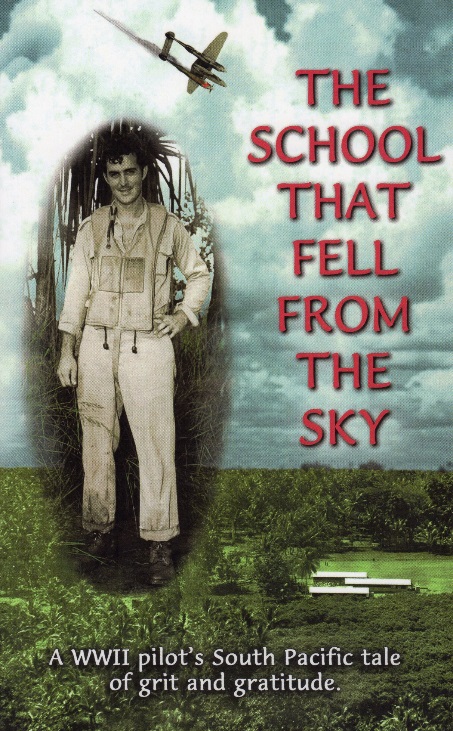
Fred Hargesheimer never forgot his villages or his villagers. After getting his life back together after the war, he decided it was payback time, so in 1961 he started fund raising to build a school in the jungle area of his evasion, to encompass the villages that had assisted evaders like himself, as no schools were available to the villagers at that time. The money came in and the school building began. It was known locally as ‘the school that fell from the sky’, and was sited in the village of Ewasse, the main village that had hidden Fred; the title of the school today is ‘The Airman’s Memorial School’. Fred and his wife worked at the school for four years to get it established, and then returned on yearly visits. Before 1961 there had been no education for native children, but since then the school has grown and it can now boast pupils from Ewasse who have graduated from Universities in Australia and had taken up senior government positions in Port Moresby, Papa New Guinea. All credit for the school must go to the evader who never forgot his helpers - Fred Hargesheimer.
Much of the above information was taken from archive information of the Australian branch of the RAFES. Information was provided by AVM Bill Townsend and David McClymont. Operational area New Britain, Papau New Guinea. Details have also been supplied from the recollections of Fred Hargesheimer in his book ‘The School that fell from the Sky’.
The Naga Queen – Ursula Graham Bower
By Roger Stanton
What follows is the brief story of a lady who has long since died, but whose service deserves recognition and whose story should not be forgotten. It is important that we in ELMS should share such information to remind the younger generations of the loyalty, dedication and courage of those men and women who selflessly performed outstanding deeds during WW2.
Ursula Graham Bower was a Roedean debutante who grew up in Kensington, London, and went to the Naga hills in Burma in the 1930s as an amateur anthropologist. At the age of 24, captivated by the country, she was living in the jungle in the Naga Hills where the Nagas still practiced headhunting. With the war clouds gathering over Europe, Ursula returned to England in April 1939 and joined the London Ambulance Service to do her war work. After a boring ‘phoney war’ she announced to her family that she was returning to Burma.
Ursula reached Kohima to be told that the Naga Hills were out of bounds for reasons of security. Stunned by the statement she was close to a breakdown. She visited the political agents but no one would change their position. Eventually they made an exception and she set off to cover the 100 miles to the Cachar Hills. The area was covered with dense jungle, high hills and mountains. She then moved onwards to the Naga Hills where a 16-year-old woman, a rebel leader called Gaidiliu, had once been active against the British; although she had been captured, the British were unable suppress her spirit. Gaidiliu was tall and elegant, and the Naga folklore decreed that she would return to the area in a different guise so that the British could not recognise her.
When Ursula finally reached the village she found herself quickly surrounded by local people; she was tall and slim, and a local man mistakenly identified her as the reincarnation of Gaidiliu. Neighbouring villages were informed and they walked from miles around to see her. When the local government heard this they decided that if the local villages wanted a goddess they might as well have a government one, and paid her. The Nagas took Ursula to their hearts. She nursed them when they were sick and when famine struck she went to the government officials and sought money for the tribes to buy food. The Nagas were fiercely independent people, but were also deeply moral and loyal. However in war they would show their enemies no mercy.
As WW2 progressed Ursula refused to leave the Naga people. Singapore, Malaya and Burma had all fallen and British and Indian troops had been retreating northwards through Burma and the Naga Hills into India, passing through her area. Ursula’s part in the war so far had been to assist the evading soldiers and civilian refugees. The high hills, covered in deep jungle, exhausted the evaders and tore their clothes and footwear to shreds. Their skin was ripped open allowing the mosquitoes and leeches to feast on their wounds. The Naga tribesmen assisted the fugitives and gathered information on the Japanese. The worry was, where would the Japanese break through the long border into India? There was a crucial need for Intelligence.
A unit of Intelligence gatherers called V Force, was formed. V Force was part of the British Army, operating under the control of Special Forces and run by British jungle trained officers. Their job was to patrol the Naga Hills on both sides of the border and report on Japanese movements. Because of her local knowledge V Force recruited Ursula. She formed her own patrols of scouts and intelligence gatherers that were responsible for over 800 square miles of hills and jungle. At first Ursula was given no food and lived off the jungle while leading her patrols. After a month’s patrolling she had lost 35lbs in weight. When this was brought to the attention of the British Commanding Officer of V Force he arranged for British rations to be supplied to her.
By the end of 1943 the Japanese had not yet mounted an offensive into India. Naga patrols searched the area and many observation posts were set up for advance warnings. In early 1944, a patrol visited Ursula’s village informing her that Japanese troops were heading her way. It was thought that they were heading towards the railway line, about 25 miles away, which was used by the British for supplies. On hearing this news many of Ursula’s patrols asked for permission to return to their villages.
Left alone in the jungle Ursula felt very depressed, but thought that she understood their reasons – they wished to defend their families. However, the very next morning they were all back on duty. They had wanted to make their wills and give their ceremonial necklaces to their families. The tribesmen told her that they were ready to fight and to die with her. They moved out of the villages and dug holes in the ground to live in where the foliage was dense. Communication tunnels were built between locations throughout the jungle.
In the event three Japanese Divisions (80,000 men) reached India to the east of Ursula’s position over-running other V Force camps. Her patrols encountered the Japanese and sent valuable Intelligence to India regarding numbers and directions. The Japanese offensive continued heading south to Imphal and north to Kohima. The British had underestimated the Japanese offensive. With a garrison of only 1500 men at Kohima they were outnumbered 10 to 1. Although surrounded, the garrison fought on until support troops arrived from India. For six weeks they had held the ground before the Japanese withdrew, leaving horrendous casualties.
In the meantime, Ursula had received fresh supplies and was continuing with her Intelligence gathering patrols. With the assistance of Ghurka troops, the defence of the villages was organised and the patrols headed off to engage the enemy. In the process they encountered many allied airmen who had been shot down and were evading the enemy. They were collected in and given food and shelter then returned to India. The American pilots could not believe their eyes when they met Ursula and nicknamed her the Jungle Queen. The British pilots called her the Naga Queen because of the loyalty she received from the Naga people. Soldiers were sent to Ursula for jungle warfare training and to gain experience in jungle fighting. One soldier described being captivated by her: ‘I would have followed her into the jaws of hell’. She was an exceptional person. The Japanese offered rewards for Ursula’s capture, dead or alive but these were mainly laughed at.
The battles of Kohima and Imphal, described as the most savagely fought battles of WW2 were over. India had been saved. General Slim summoned Ursula to visit his HQ to congratulate her on her achievements. She then returned to the jungle to ambush and harass the Japanese retreat. Over 80,000 Japanese had entered the area four months earlier to march on India. About 25,000 left the area alive. Japan had suffered its greatest military defeat in its history. The defenders of Kohima, Imphal and the harassing patrols of V Force had done their job.
Her job completed, Ursula’s V Force detachment was disbanded in November 1944. In recognition of her bravery, Ursula was awarded an MBE and also the rare Lawrence of Arabia Medal. She married a former V Force Officer in 1945 and in 1948 returned to Great Britain, although she missed the hills, the jungle and the brave Naga people who had given her their total loyalty. Ursula Graham Bower MBE died in 1989.
Further information on Ursula Graham Bower can be found at the Pitt Rivers Museum in Oxford where her Naga head-hunter’s shield is held, together with many photographs and archive material on her wartime activity.