Comete Trail
The Comete Freedom Trail
The Comète Line was one of the most successful escape routes of the Second World War, shepherding Allied airmen—over twenty nationalities in all—from Brussels through Paris and the Pyrenees to neutral Spain. Founded in the Belgian capital, the network relied on couriers, passeurs and safe-house keepers across Belgium, France and Spain who repeatedly rebuilt the line after German crackdowns. The commemorative Freedom Trail honours those helpers and the families who continue to welcome walkers today. The wartime journey usually began by train from Brussels to Paris and onwards to the south-west Pyrenees. Once in the Basque Country the evaders were moved rapidly: safe-houses in Bayonne or Saint-Jean-de-Luz offered food and shelter before night marches into the hills. The River Bidassoa marked the border between France and Spain, and crossings were carried out after dark in hostile weather conditions with border guards patrolling both banks. Guides treated injuries, supplied clothing and secured onward transport deeper into Spain. ELMS partners Les Amis Comète host the principal commemorative walk each September, tracing a representative 26 mile route from Saint-Jean-de-Luz to San Sebastián. Memorial services, wreath-laying and visits to wartime safe-houses frame the two-day hike, while Basque hosts share local history at each waypoint. Many of the original helpers paid with imprisonment, torture or execution. Others disappeared into the concentration camp system of the Third Reich. The modern trail is dedicated to the helpers of all nationalities whose actions kept the Comète escape line open throughout the war.
All walkers on this event must ensure that they are capable of undertaking an arduous walk over hilly and rugged terrain often in high temperatures. Participants, especially family members of former evaders, should be aware that the route followed by this trail is known as ‘The St Jean de Luz Passage’ and that there were at least a further four Comete routes in the area that were used at various times. The commemorative St Jean de Luz route is intended to be representative of all those routes used by Comete.
Commemorative Event
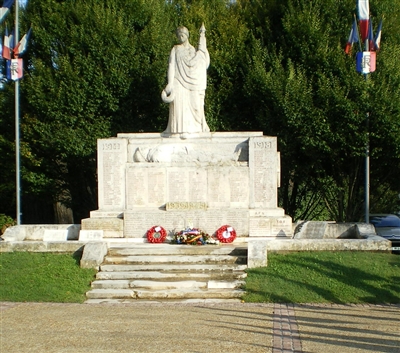
Friday – Walkers and veterans join the programme of Les Amis Comete. At 1045hrs, all participants gather at the St Jean de Luz War Memorial for a wreath laying ceremony. Members later gather at Bayonne Cemetery to lay tributes on the grave of ‘helpers’ Edouard and Cyprienne Dassie. There is also a visit to pay respects at the Villa Voisin, the safe-house ran by the Belgian de Greef family. A memorial service is held at the Anglet War Memorial at 1730hrs, followed by a reception. Return to St Jean de Luz is at about 2200hrs.
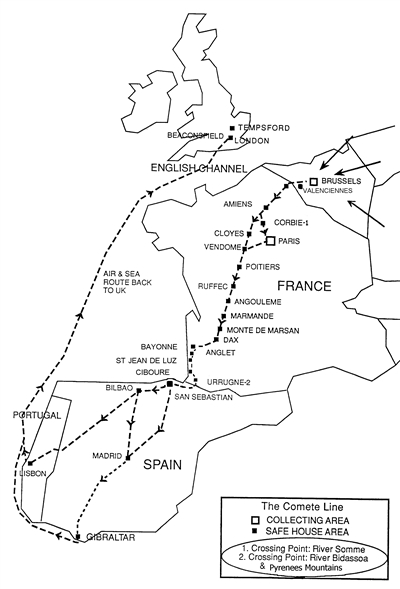
This commemorative walk follows the St Jean de Luz passage, one of four documented Comete routes across the Pyrenees
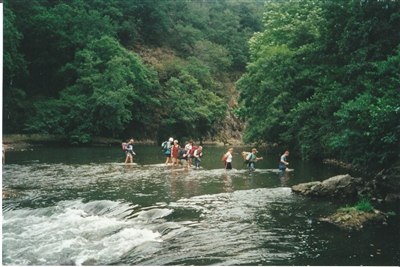
Saturday - Walkers and veterans gather at Socoa Cemetery at 0900hrs, when wreaths are laid on the graves of Florentino Goicoechea and Kattalin Aquirre. This is followed by breakfast hosted by the Ciboure Municipality. The walk starts at 1000hrs. Walkers follow roads and tracks to Urrugne, where there is a ceremony at the War Memorial at 1200hrs, followed by lunch. At 1300hrs, the walk continues via Francia Usandizanga’s safe-house at Bidegain Berri; Francia died in Ravensbruck on 12 April 1945. The route then moves into the hills and onwards to the River Bidassoa. The ‘going’ is moderate, having boulder-strewn tracks in places, low hills, and wooded areas. There is a short, steep descent to the River Bidassoa, arriving at the crossing point at San Miguel at approximately 1730hrs. Wakers wade the river using a safety rope; a long stick/pole is recommended for balance and walkers should wear appropriate footwear that has been carried especially for the crossing - the bed of the river is covered in sharp stones. The San Miguel crossing point was used by Basque guide Florentino and the evaders during WW2. A BBQ on the river-bank, organised by Spanish members, completes the day. Return to St Jean de Luz is at approximately1900hrs
Sunday – At 0700hrs walkers meet at St Jean de Luz Railway Station to board the bus returning them to the River Bidassoa to continue the trail. The walk resumes at approximately 0800hrs continuing to Sarobe Farm, the first safe-house in Spain, arriving at approximately 1230hrs. There is a short stop at Sarobe Farm, then the route continues to Renteria and the finishing point at a Cider Restaurant at about1500hrs. Transport returns to St Jean de Luz at 1830hrs. [All timings are approximate & can vary annually]